事實上,接受短期的專案,與長期建立可以 Scale Up 的商業模式,必定會有一定的衝突。例如,我曾經遇過不少創業者,一開始接到知名企業的案子,很開心和我們的分享業務開發的成果,也以此作為產品的成功案例,再去開發其他商業機會、參加創業競賽、向投資人募資。幾個月後,繼續跟我們分享又接到了幾個知名的企業的合作案。然而,又過了幾個月後,最終的結果,卻是他每天忙著和不同的客戶開會,把所有的開發資源都先挪給客戶的專案,期待完成後可以有一筆豐厚的營收進帳,客戶卻在最後一刻,因為內部規劃方向改變,整個案子腰斬,不僅沒收到錢,還損失了大把時間,而時間是創業者最珍貴的資源,背後有很高的機會成本,因為花了一、兩年全力開發的企業專案,很可能導致新創喪失其他更重要的市場機會。
每家媒體,都有自己的內容定位與 TA,每位記者,也都有各自擅長的領域與路線。預先從媒體網站或 Google 搜尋,可以掌握到這些資訊,讓創業者可先行了解,這次的採訪,是透過擅長什麼領域的記者、什麼定位的媒體,傳遞資訊給什麼類型的讀者。例如,對於財經為主的媒體,受訪時就不要講太多科技、技術名詞,多分享故事、案例、難忘的經驗、商業模式、產業前景等內容。
對找到 Product Market Fit 的新創來說,正面的媒體報導,的確有加速宣傳、擴大戰果的成效。但媒體登門採訪的機會,畢竟有許多機緣因素,未必完全操之在己。在採訪前的準備、採訪當下的精準回覆外,我也建議找到 Product Market Fit 的創業者與新創,平常就該有所準備與投資,為未來的媒體採訪與報導鋪路,或是在媒體報導之外,提供更多資訊,主動觸及 TA 或消費者。
我很偶爾會聽到創業者這樣抱怨:「記者採訪前都不做功課、對我們不夠了解。」這背後,其實反映了創業者缺乏換位思考的迷思,我通常會再問:「如果在網路上 Google 搜尋你們,只有公司地址、統編這些工商資訊,官網上的 About Us 簡短到不到一百字,你要記者怎麼做功課?」
多數新創,初期當然鮮少媒體報導,但這不代表不能自己做 PR。持續充實、更新官網的內容,或是不斷優化 About Us 的資訊 (例如創業理念、商業模式、創辦人故事、重要里程碑等),甚至是長期且穩定地經營 Blog 等 Owned Media 內容,都是被動等待媒體報導之外,更重要的 PR 投資。有策略地經營 Owned Media,再加上陸續開始吸引有觀點、有角度的優質媒體報導,將可讓新創在找到 Product Market Fit 後,更有效率地 Scale Up,讓商業的飛輪加速運轉。
Jun is an Analyst covering both AppWorks Accelerator and Greater Southeast Asia. Born and bred in America, Jun brings a wealth of international experience to AppWorks. He spent the last several years before joining AppWorks working for Focus Reports, where he conducted sector-based market research and interviewed high-level government leaders and industry executives across the globe. He’s now lived in 7 countries outside US and Taiwan, while traveling to upwards of 50 for leisure, collectively highlighting his unique propensity for cross-cultural immersion and international business. Jun received his Bachelors in Finance from New York University’s Stern School of Business.
As the world came to a standstill from COVID19, the first half of 2020 proved to be a challenging time for industries across the board. With all its promises and potential, even the nascent blockchain industry was not immune to worldwide lockdown and social distancing measures. A handful of established players certainly benefited from the accelerated shift to online consumption and digital living. But, those projects without solid foundations, compelling use cases, and sustainable business models quickly found themselves at the end of their runways.
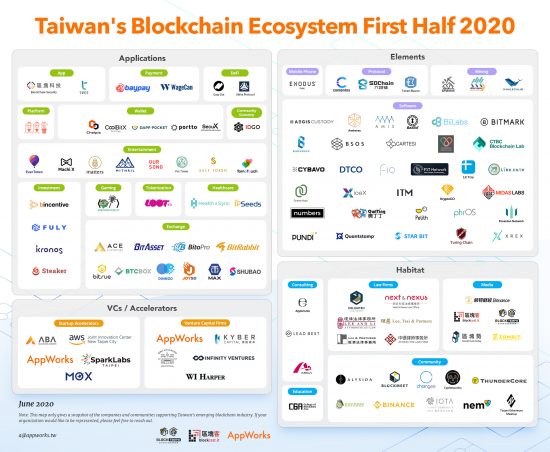
With only 447 confirmed cases and 0 local transmissions in the last two months, Taiwan has garnered worldwide adoration for its handling of the novel coronavirus. The local blockchain industry, however, did not go completely unscathed. Compared to 19H2, 21 projects have since ceased operations and been taken off the map. This is the largest number of removals since AppWorks Accelerator started producing the ecosystem map two years ago. With only 16 additions, there were also a fewer number of new organizations entering the ecosystem compared to any other half. Collectively, there was a total of 112 projects noted on the map, down from 115 in the last update.
2020 is clearly shaping up to be a year of reckoning. Financial markets are in disarray, global supply chains have been crippled, and economies across the globe are struggling with unprecedented productivity loss. That said, if 2008 was any indication, heroes are often born in the midst of a crisis. The pandemic has highlighted glaring efficiency and reliability gaps in our current processes and systems, forcing upon us new ways of working and thinking. “The new normal” may very well serve as the necessary accelerant to convert blockchain’s perception of cautious skepticism into widespread pragmatism, which we’re already starting to see early signals of.
Enterprise adoption picks up
There’s been a lot of talk about how and when to potentially use blockchain. Now, it seems like enterprise adoption is starting to pick up steam. As many of them lack the capabilities in house, we’ve seen several corporates in the last six months announce their latest initiatives in partnership with local blockchain startups.
Taiwan’s leading financial conglomerate with over US$335B AUM Cathay Financial Holdings announced that it’s developing an electric vehicle IoT financing platform in conjunction with EV charging service provide ChargeSmith (AW#16) and supply chain-focused blockchain startup BSOS. The new platform collects and stores EV owners’ driving behavior, which will then be used to provide real-time personalized financial services ranging from insurance to banking products. In another example of enterprise partnerships, longstanding email security provider Openfind unveiled its collaboration with BlockChain Security to launch an intellectual property protection solution, which aims to help enterprises store and transmit confidential information more securely.
It’s no secret that banks have been some of the earliest adopters of blockchain technology in Taiwan, as seen by Cathay and CTBC, the latter of which runs its own blockchain incubator and is a part of international blockchain consortium R3. Taiwan Business Bank was the latest to hop on the bandwagon. They recently unveiled their intentions to implement blockchain technology into the process of issuing confirmation letters in order to lower the risk of falsification.
Meanwhile, crypto asset management platform Bincentive recently disclosed its partnership with Japan-based Rakuten. Users of the international e-commerce site will now be able to purchase crypto investments using their loyalty points. Along the same lines, BitoEx (AW#6) which operates one of Taiwan’s largest crypto exchanges now allows FamilyMart members to redeem their loyalty points for bitcoin purchases.
Thus far, Tawianese corporations are clearly displaying a positive embrace of blockchain technology. However, due to their traditional management structure, implementation of the technology is still veered towards a centralized model, inhibiting some of the touted benefits of blockchain such as autonomy, no single point of failure, and overall the democratization of data and authority. Moving forward, it’ll be worth observing how enterprises might adjust their cultures and governance models as decentralization increasingly transitions from fringe to mainstream adoption.
The new normal
Blockchain has been in development for well over a decade now, and the crypto market has correspondingly undergone its fair share of cycles. In the process, investors have become increasingly more sophisticated in terms of their understanding and approach to the market, as well as the instruments and structures they use to finance deals. Nevertheless, crippled economies across the globe have led investors to reel back their money for the time being, allocating their attention to existing portfolios or waiting for brighter horizons.
With the current circumstances, the development of early stage startups has become polarized. The market will be unrelenting for those relying on projects to generate ad hoc cash flow, as the downturn has caused a tightening of the belt for customers across the board. On the other hand, those teams that have found product-market fit and solve a real world pain point for clients at scale will have greater commercial prospects, ultimately contributing to a stronger and more sustainable ecosystem that’s driven by a project’s actual value rather than market hype and speculation.
There were a few bold blockchain entrepreneurs, for example, with innovative technology and solid business models that were highly favored by investors. CoolBitX successfully closed a US$16.75M series B round of financing, led by SBI Holdings. The newly raised funds will be used to continue development and rollout of its messaging-based KYC/AML solution for virtual asset providers. In addition, BSOS also completed a million-dollar seed round in the first half of 2020—including NT$20M (US$678K) from Taiwan’s National Development Fund—to advance its blockchain-based supply chain financing solution for enterprises.
Digitalization vs decentralization
Looking back in the first half of 2020, it was a rather harrowing time for the blockchain industry. Right at the onset of COVID19 in March, cryptocurrency prices dropped by 40%. A few months later in May, Telegram—which in 2018 raised the second largest ICO in history at US$1.7B— announced the suspension of its blockchain project the Telegram Open Network (TON) shortly after the SEC won a preliminary injunction, citing a plausible case that Telegram had sold unregistered securities in its coin offering.
Crypto prices have since more or less recovered to pre-COVID19 levels, especially as people increasingly sought out alternative stores of value like bitcoin as a hedge against inflationary currencies. The halving of bitcoin this past May and the added supply scarcity will likely continue to drive up its value, as it’s done so consistently in the past. Since TON was officially abandoned, there have been many communities around the globe that have been rallying to keep it alive, including the Chinese TON community which claimed that it would launch its own version of the blockchain.
At this point, what are the next growth opportunities for blockchain? Everyone has different interpretations and expectations. However, currently, conversations are mostly centered around the pandemic, with criticisms mainly targeted at the limitations and failures of centralization. Whether it’s in terms of tracing vaccination records, tracking medical supplies, eliminating fake news, or disbursing economic aid, decentralization has been thrown in as a prominent solution to many use cases. However, as impactful as these use cases may be, the reality is that boilerplate digitalization is still higher on the pecking order for most people. The age of remote work catapulted people into a new normal, forcing everyone to figure out how to do everything over the worldwide web, from basic necessities like ordering food or groceries to lifestyle needs like exercise and socialization to work needs like conducting meetings or business presentations.
Digitalization and decentralization are not mutually exclusive, however. If anything they are complementary. Novel thinking often calls for novel solutions. Decentralization can provide the perfect combination of efficiency, transparency, and autonomy that people didn’t even know they wanted or needed. For now, aside from decentralized finance (DeFi), games and entertainment-related services will likely dominate the majority of use cases, both of which benefited tremendously from the pandemic in terms of adoption and usage.
Existing entrepreneurs in this space would be wise to continue building their experience in this area, acquiring users, and strengthening their positioning. For aspiring entrepreneurs, realize that the world has hit reset and undergone a rude awakening; consequently, there’s never been a better time to explore and introduce radical new ideas.
Taiwan’s Blockchain Ecosystem Map First Half 2020 is produced by AppWorks and updated every six months. If you have any comments or suggestions, please send us an email at [email protected].
【If you are a founder working on a startup in SEA, or working with AI / Blockchain, apply to AppWorks Accelerator to join the largest founder community in Greater Southeast Asia.】
Natalie is an Analyst covering AppWorks Accelerator and Greater Southeast Asia. Before joining the team, she worked in the search engine marketing and email marketing teams at Zappos, America’s leading shoes and fashion online retailer, where she primarily focused on KPI management, campaign optimization, and project management. Born in Canada and raised in the Middle East, Natalie returned to Taiwan for high school before moving to the US for college and work. She received her Bachelors of Marketing at Case Western Reserve University in Cleveland, Ohio. Outside of work she likes to read, travel, and play video games.
As a founder thinking about Taiwan, engineering talents and a sizable and well developed digital ecosystem are normally at the top of mind. But increasingly entering the mix now is Taiwan’s growing AI capabilities. It is a result of both industry trends and government policies. In her inaugural speech given in May, re-elected President Tsai Ing-wen mentioned six core strategic industries for Taiwan that included an acceleration of AI and IoT while highlighting the future of digital and data.
In order for an AI ecosystem to flourish, both the government and the private sector must embrace and work to build it. In October 2019, the National Center for High-Performance Computing co-worked with Quanta Computer, ASUS, and Taiwan Mobile to build TAIWANIA 2, a supercomputer built for AI, which offers its cloud service through Taiwan Computing Cloud (TWCC). Since its commercialization, TAIWANIA 2 has driven over 300 projects from industries, academia, and research organizations. 10 million GPU computing hours have been utilized, AI training time has been reduced by 90%, and the efficiency of deep learning has been raised 498 times. The added capacity far exceeds the current computing demands of Taiwan’s AI industry, seamlessly aligning with the country’s national strategy.
As Taiwan gradually becomes a major AI center for the development of Greater Southeast Asia (ASEAN + Taiwan), tech companies are starting to pay attention. Microsoft has already promoted their AI Infinity program to recruit talents and set up R&D centers. In addition to covering commercial AI solutions, think tanks are being set up and Microsoft is also cooperating with National Chengchi University to open AI business courses for enterprises to understand how to implement AI to accelerate transformation within their company.
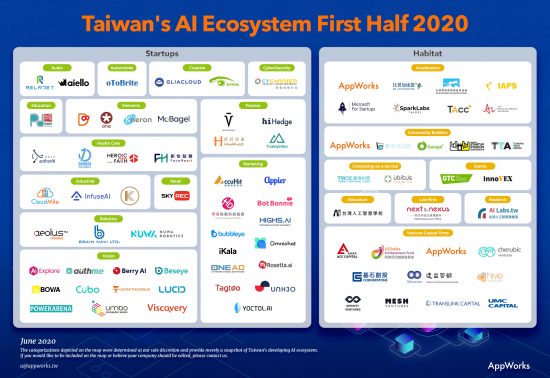
Although the new virus that broke out in the first half of 2020 halted some commercial activities and significantly impacted many existing industries, the epidemic did not stop the development of Taiwan’s AI ecosystem. In the process of updating the 2020 H1 Taiwan AI Ecosystem Map by AppWorks Accelerator, we found that in the last 6 months, there have been several trends worth noting:
The retail industry was forced to go online during the pandemic, giving digital marketing a platform to shine
During the pandemic, consumer behavior has changed. Their shopping habits accelerated from going to physical stores to switching to online channels instead. How companies can stand out in the online world has become a new learning curve for retailers. This epidemic will not only accelerate the speed of digital transformation of the traditional retail industry, but also give rise to smart retail, which integrates online and offline experiences as their focus.
In the past few years, we’ve noticed that AI innovation focusing on digital marketing operations have sprung up. By using AI technology to accurately do ad placements, track user journey and behavior, and analyze the collected data, companies are able to outline consumer profiles and thus more accurately predict consumer shopping preferences and price orientation, creating personalized shopping experiences for each visitor.
Even visitors that don’t end up converting or placing an order provides a gem of data analysis. Companies can use AI and big data to target this group of potential customers who have yet to make a transaction by carrying out remarketing campaigns to improve conversion rates and overall marketing performance.
The opportunities are endless under this trend, especially for startups. In February 2020, MarTech startup Accuhit, which just raised a NT$ 70 million pre-A round, provides both subscription-based use and project-based consulting to analyze customers’ historical purchasing behavior and make predictions. Omnichat (AW#16), an alumni of AppWorks Accelerator, specializes in a marketing automation subscription service that provides multi-channel conversational commerce focusing on ecommerce clients. The platform has an average conversion rate 3x to 7x higher than the overall trend in ecommerce. They recently completed a seed round earlier this year, led by AppWorks Funds.
An explosive introduction of AI applications in healthcare
Alongside digital marketing, AI is also thriving within the medical field. According to Global Market Insights, the global healthcare AI market will reach US$ 13 billion by 2025, with an average annual compound growth rate (CAGR) of 40.6% from 2019 to 2025. Over the past six months, particularly during this pandemic, AI usage in improving the efficiency of medical consultation and disease screening is at an all-time high.
Taiwan has accumulated years of experience in the development of AI in healthcare. Since medical AI algorithms require a large amount of labeling data in order to train the model, as early as 2018 the Ministry of Science and Technology (MOST) co-worked with National Taiwan University, Taipei Veterans General Hospital, and Taipei Medical University to open the first pathology database for cross-institutional annotated medical images in Taiwan. These kinds of developments not only help physicians accelerate medical image interpretation and improve the consistency and accuracy of diagnoses, but also shorten the time for patients to seek medical treatment and reduce invasive examinations.
In the startup ecosystem, we also see a rise in the development of AI in healthcare startups. We see applications like developing AI technology for over a billion pixel image analysis and high-performance computing (AI HPC) with AI Explore; medical imaging AI platform services with aetherAI; medical staff assistance to interpret Computer Tomography (CT) scans for cerebral hemorrhaging with Deep01; and during this epidemic, Heroic-Faith developed a smart respiratory monitoring system.
A friendly ecosystem for AI startups is gradually taking shape
As more AI startups plan on expanding to other markets, Taiwan is considered a hotbed in terms of startup accelerators, education, and research for AI founders to leverage the ecosystem. On the accelerator side, AppWorks Accelerator was established in 2010 and focuses on recruiting AI / IoT and Blockchain founders only since August 2018 (AW#17). So far, it has recruited 89 of these startups, with 44 of them being AI and 16 of them being IoT. Together these startups are well positioned to further accelerate Taiwan’s burgeoning AI ecosystem.
In addition to AppWorks, there are many other accelerators supporting the AI ecosystem in Taiwan. Microsoft for Startups, Sparklabs Taipei, Taiwan AI x Robotics Accelerator, and more are all community builders that recruit AI startup teams. Under this AI wave, other accelerators that aren’t focusing on AI have also found success in recruiting AI startups, such as TAcc+ and BE Accelerator.
In VC, investment in AI companies have also grown year-over-year, providing financial assistance to AI startups looking for growth or expansion opportunities. For example, AppWorks Funds is a VC focusing on the three themes of AI, Blockchain, and Southeast Asia. Other well-known VCs in Taiwan include ACE Capital, Cherubic Ventures, TransLink Capital, and more have also greatly invested in AI in the past 2 years. Related Taiwanese investments to AI startups include CloudMile, Umbo CV (AW#9), Cubo AI (AW#16), and MoBagel (AW#16).
In Taiwan’s thriving AI ecosystem, new AI developments can be seen in various well-known technology exhibitions and forums. At the annual COMPUTEX conference, there’s a new startup-themed exhibition called InnoVEX that has attracted many talented AI founders to sign up to build bridges with investors and enthusiasts from all over the world. This year due to the pandemic, COMPUTEX was cancelled for 2020 and InnoVEX changed to #InnoVEXOnlineDemo. NVIDIA also held their famous AI conference NVIDIA GTC (GPU Technology Conference) in Taipei in 2018, providing opportunities for all stakeholders to meet and each other. GTC Taiwan 2020 is expected to be held this year in Taipei.
Taiwan AI Academy and Taiwan AI Labs are still Taiwan’s representative institutions in the field of AI education and research, respectively. They continue to inject talent and innovation to Taiwan’s AI development. There was a tragic loss for the community of Taiwan’s AI ecosystem as Sheng-Wei Chen passed away earlier this year. He was the CEO of Taiwan AI Academy and founded the organization that has cultivated more than 6,000 talents for Taiwan in the span of 2 years. His contributions include progressing the mission of transforming industries with AI, making data science known as his north star, and growing AI talent. He and his work will forever be remembered by Taiwan’s AI growing community.
Taiwan’s AI Ecosystem Map First Half 2020 is produced by AppWorks and updated every six months. If you have any comments or suggestions, please send us an email at [email protected].
【If you are a founder working on a startup in SEA, or working with AI / Blockchain, apply to AppWorks Accelerator to join the largest founder community in Greater Southeast Asia.】