
DeFi already has Aave. So the first question anyone may ask is why build another lending protocol.
Yet if one digs deeper, they will realize capital fragmentation still creates a huge structural inefficiency in DeFi today. The same dollar of collateral that backs a loan on Aave cannot also be an LP position on Uniswap. Aave, Compound, and Uniswap each wall their liquidity off from one another, so capital sits in one silo doing one job. Therefore, the world does not need another lending protocol, but we can all benefit from solving this structural inefficiency.
That’s why the world needs Fluid: it collapses those walls. The same collateral that secures a loan can finally also provide trading liquidity at the same time, and it shows up the cleanest measure of capital efficiency, revenue per dollar of TVL, where Fluid runs about 0.43% in 26Q1, the highest of any lending protocol.
But the number is not why we invested. What we care more is the team who can break the constraint while others just live with that.
Samyak Jain: The math geek who rebuilt everything from first principles
Samyak and his older brother Sowmay grew up in Kota, India’s academic-pressure capital. Samyak watched The Social Network in ninth grade and decided he wanted to start a company. He was a math prodigy and a competitive chess player. Sowmay started trading Indian stocks in high school and wrote his own apps to track them, and Samyak joined in to write the code. That was their first project together, and it ran straight into the walls of traditional finance, where your age, a missing license, or a lack of capital can simply lock you out.
On his first day of college, Samyak told his parents he would drop out the moment he found an idea worth it. The idea showed up fast. In August 2018 the brothers entered the ETHIndia hackathon, built a tool on top of MakerDAO, and won. The takeaway stuck with him: two college students could write code that managed millions of dollars, and no one could stop them. They were crypto-native from the start, with a MetaMask wallet before a bank account. In 2019 Pantera and Naval backed them with $2.4M, Samyak dropped out, and they went all in on Instadapp. It became DeFi’s leading middleware and peaked at around $12B in TVL.
Then came the moment that decided everything. In 2022, when LUNA collapsed and stETH lost its peg, Instadapp’s Lite strategy came close to roughly $1B in liquidations, and the team scrambled through emergency loans to survive. Samyak’s own summary is that those three days taught him three years’ worth of risk lessons. The most important one was simple and uncomfortable: middleware sits on top of other people’s protocols, and you cannot fix a broken foundation from the top. Most founders sitting on a $12B protocol would have kept shipping features. Samyak did the opposite. He stopped iterating on Instadapp and spent close to a year and a half rebuilding lending from the ground up, around one question: what would a bank look like if you built it from zero on-chain?
Early 2026 put both the founder and the architecture through two real tests. In March, an attacker exploited a partner protocol, Resolv, and pushed about $80M of unbacked tokens into Fluid. Two things saved it. Fluid’s automated risk limits capped how much damage that bad collateral could do before any human reacted. And within about half a day, the team had sized the loss, lined up interest-free emergency loans from partners like Cyberfund and Jupiter, and publicly guaranteed user funds, which stopped a panic before it could start.
The second test was system-wide. In April, a hack at Kelp set off a bank run across DeFi: everyone rushed to pull ETH out of lending markets at once, Aave’s ETH was fully borrowed out, and the cost of borrowing ETH spiked everywhere. Within hours, Fluid shipped a tool (its aWETH Redemption Protocol) that let lenders who were stuck in Aave get their ETH out, and in the process reduced Fluid’s own exposure at the same time. Fluid came out of the crisis looking like the lender of last resort.
Fluid could have simply waited for Resolv to resolve its own exploit. Instead the team acted first, taking measure after measure to make sure user assets were protected. That perseverance, and the instinct to put user funds ahead of everything else, is what impresses us most. This is the kind of founders we at AppWorks are proud to back: those that are willing to rebuild from zero. On top of that, across both crises, what stood out was the speed and capability with which the Fluid team handled them.
Beyond the design: how Fluid grows
We won’t rehearse the mechanics here. The design is genuinely clever, with three pieces doing the work (Smart Collateral, Smart Debt, and the liquidation engine), and Cyberfund has already written the clearest explanation of how they fit together in its two-part Demystifying Fluid series.
What we like just as much as the design is the go-to-market. Fluid runs its own protocol and is still building its own community, but its biggest growth lever is distribution: it takes the same engine and plugs it into channels that already have millions of users, instead of trying to win every user directly.
Jupiter is the clearest example. It is Solana’s largest trading aggregator, so Fluid provides the lending engine, Jupiter brings the users, and together they launched Jupiter Lend with the economics split roughly fifty-fifty. The deal closed fast because the founders already trusted each other. On BNB, Venus, the chain’s largest lending protocol, now runs on Fluid through Venus Flux. And institutional curators are starting to arrive: Bitwise runs an Ethena market on the Fluid-powered Jupiter Lend, the first institutional-grade curator on the system.
It is worth being precise about where the moat comes from. The obvious part is lock-in: once Fluid is the lending engine underneath a partner like Jupiter or Venus, ripping it out is so costly that almost nobody does, and Fluid gets there without paying for users through token emissions, the most expensive game in DeFi. But the deeper moat is less glamorous. Running a lending book well is genuinely hard operational work. Every collateral type needs its risk parameters set and watched, liquidations have to stay ahead of fast-moving markets, and the whole book needs constant risk management. Most teams do not want to touch any of that, which is exactly why being the team that does it well, on everyone else’s behalf, is so hard to dislodge. It also just makes economic sense: powering a partner earns Fluid far more than launching yet another vanilla lending protocol on its own would, so the partnership pays off for both sides.
That points to the bigger picture: Fluid is really a two-sided platform. On one side are the distribution channels we just described, the apps and chains that want a lending and trading engine without building one themselves. On the other side are the projects that need liquidity, like stablecoin and real-world-asset issuers, who can use Fluid’s pools to bootstrap a market far more cheaply than hiring a traditional market maker. When the reUSD stablecoin launched on Fluid, its TVL and trading volume jumped in a single day, and it has since spread across multiple chains. Fluid sits in the middle and makes both sides more capital-efficient than they could be on their own.
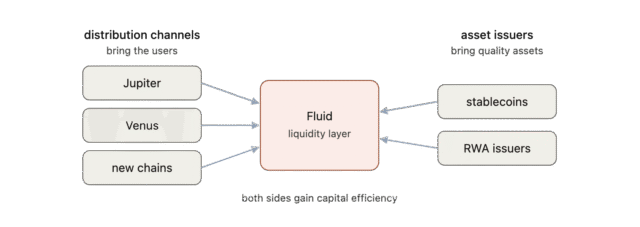
The thing to understand is that these are not separate product lines. They are one architecture. Fluid is a single liquidity layer that any number of protocols can plug into, where the same capital is reused across spot, perps, FX, and credit. DEX, Perp, and FX are not different businesses, they are the same engine reaching into new asset classes, and each one adds revenue without needing fresh TVL. The north star is to rebuild banking from zero on-chain: to become the engine behind banks and neobanks, to bring real-world assets on-chain, and to make the kind of 95% LTV borrowing that today only billionaires with private bankers can get available to everyone.
—
We’re thrilled to back Samyak and the Fluid team as they rebuild banking from first principles on-chain, turning capital efficiency from a feature into the primitive the next financial system runs on.
And if you are a founder building on-chain banking from first principles, we would love to talk.
