with contribution from Natasha Chou, Alumni Relations Manager at AppWorks
The most valuable part of working with AppWorks’ large founder community is watching founders iterate, in person, every single day. Especially since OpenClaw arrived at the start of this year, founders seem to have been handed a brand-new torch, and they are using it to find out how many previously impassable tunnels AI can lead an organisation through.
Since April 2025, AppWorks has hosted a monthly AI Founder Circle at our Taipei office, and a bi-monthly edition has since started in Singapore where AppWorks has 98 active startups in the community. After more than ten Circles, the topics have evolved along the way: from how to use OpenClaw to how to build your own AI agent; from how to get employees to adopt AI smoothly, to building AI employees and standing up a full agent-harness platform… and now we have arrived at a new frontier: the old shape of the organisation no longer seems to fit.
Optimising the organisation has always been a rite of passage on a startup’s growth path. Almost every company starts as an agile squad of fewer than ten people, fully aligned and all-in every day. Then, as it grows, it seems obliged to follow in the footsteps of the big companies that came before: departmentalise, divisionalise, and start to feel the growing pains. When a company first reaches a size of 100 to 200 people, it will start to experience the pain of an organisation that gets bigger while its efficiency does not.
To build a big business, you need many hands on deck; but the more people you have, the harder they are to manage, because the bandwidth of human communication is limited. AI seems poised to relieve this millennia-old management pain: it moves information in greater volume, at greater speed, and with less of the distortion that comes from passing through many hands.
Pioneering founders and executives have already begun to experiment. In March, Jack Dorsey put forward the hypothesis of a fully flat organisation (see From Hierarchy to Intelligence, co-written with Sequoia Managing Partner Roelof Botha); in May, Cloudflare CEO Matthew Prince wrote in The Wall Street Journal to explain why he was laying off and replacing staff at a moment of rapid revenue growth and healthy cash flow (How I Choose Which Cloudflare Employees to Replace with AI); and in July, Jamie, our AppWorks Founder and Chairman, published 《逆分工》 (Reversing the Division of Labour) with Taiwan Mobile CIO Rock Tsai, exploring the productivity revolution of the AI era.
In Asia, many founders are now running the same experiment, and through their first-hand experience and iteration we have had the privilege of a close-up view. In this article we put forward a hypothesis about the shape of organisations in the AI era, and invite the founders holding the torch to glimpse the future with us — and we will also explain why the new shape is only the ticket in, not the endgame.
We have also asked several founders, at different stages and scales, to share the experiments they are running and the results so far, so this is not merely a theory proposed by AppWorks, but the product of generous contributions from the AppWorks founder community.
Every technological revolution reshapes how we organise
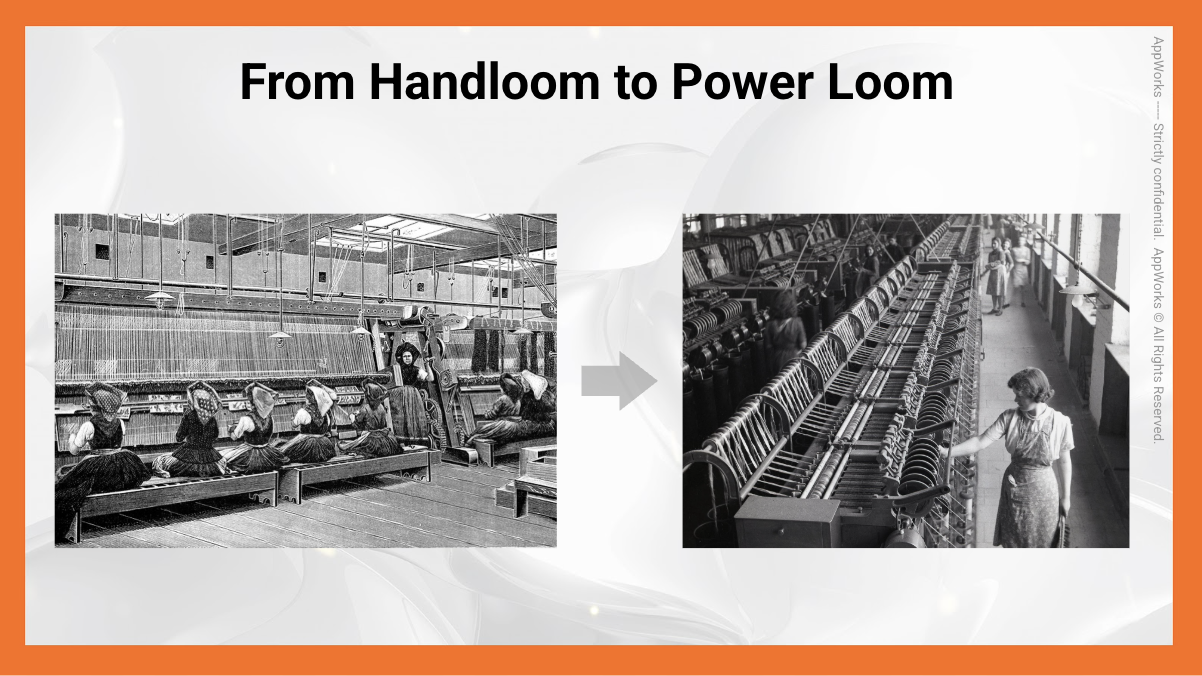
Every technological revolution reshapes how we organise, and it has happened at least twice before.
The first time was in the textile mill. Before the 18th-century Industrial Revolution, the handloom was merely a tool; the craft lived in the weaver, one weaver per loom, and output was capped by the number of hands. When the power loom arrived, the machine absorbed the craft, and the human’s job became tending the machine. One person now oversaw an entire row of looms, and the work shifted from weaving by hand to setting the standard and catching the exceptions. Walk into a TSMC fab in 2026 and you still see this shape: the most advanced process engineer is not the craftsman of any single wafer, but the keeper of the machine’s yield.
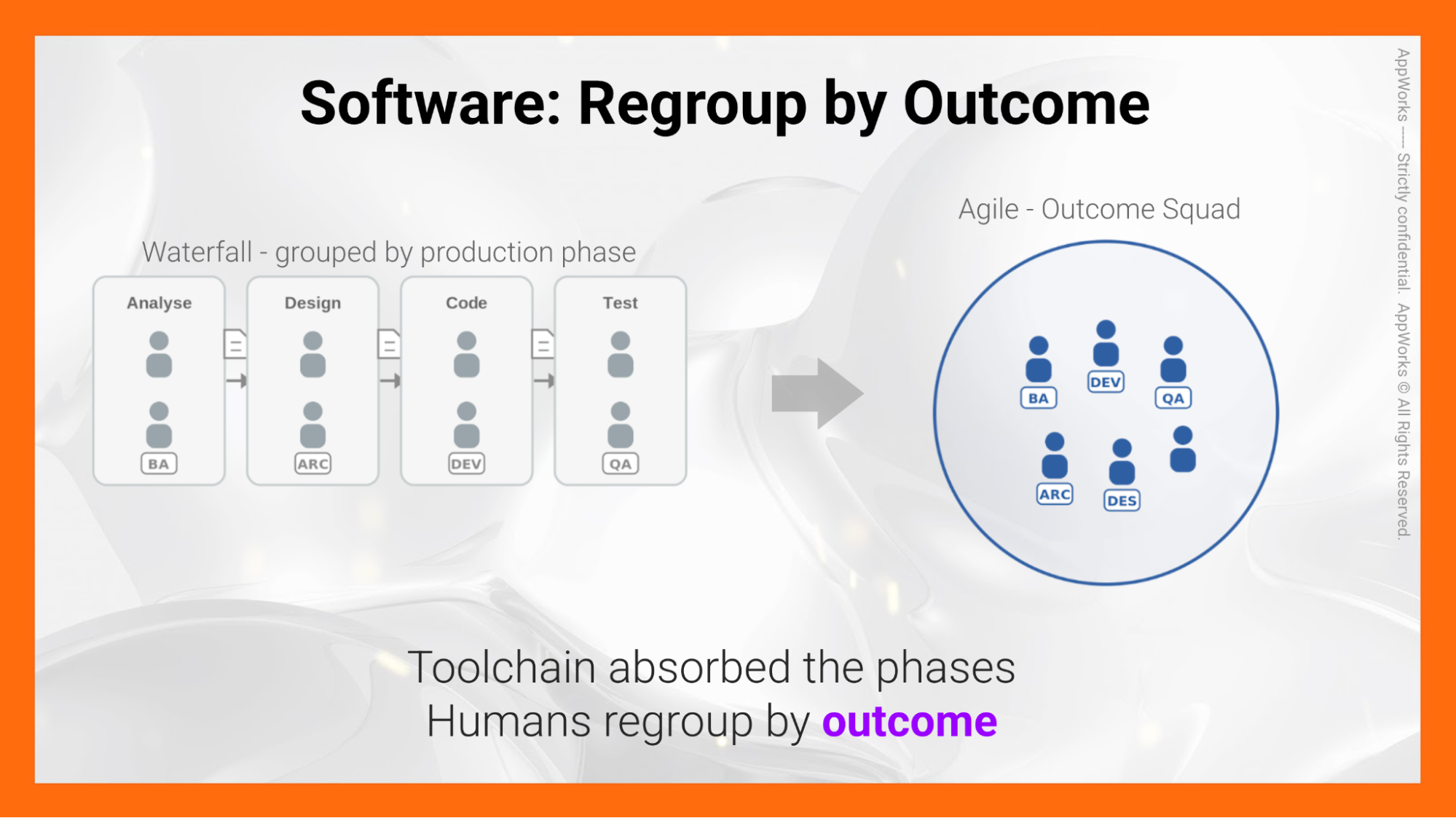
The second time, it was software’s own turn. From mainframes to personal computers to the cloud, engineers’ tools have a peculiar property: anything that can be written down as a rule, the tool can do for you — and the first thing it took over was proving that the person before you hadn’t got it wrong. Early waterfall grouped people by process step — analysis, design, coding, testing — four departments handing off in sequence, with documents as the stitching. What that documentation really did was carry trust from one runner to the next. Once version control, automated testing and continuous integration turned verification into a machine’s job, and the cloud turned shipping from a one-shot, live-or-die event into something you could roll back at any time, the handover documents had nothing left to prove. What collapsed wasn’t labour hours; it was the cost of making mistakes and of coordinating. Change the costs and the shape reorganises to match. From roughly 2001 onwards, agile made cross-functional teams the mainstream of the software industry: product, engineering and design sitting in one small team, jointly accountable for a specific outcome like “raise homepage conversion”. (Spotify later called such a team a squad.)
Shape never follows the prevailing ideas; it follows what actually works. That also explains a piece of industry history: over the past 25 years, agile has almost never genuinely succeeded outside the engineering teams of internet companies, because what can be moved is the ceremony, and what can’t be moved is the machine underneath it. Other departments’ systems record work; they don’t do the work, and they certainly don’t check the work. A CRM records customers, but it doesn’t talk to them, and it won’t tell you the call went badly. Without that machine, what a cross-functional team delivers doesn’t get any better — it just changes how the meetings are held. So the ceremonies stay, and the shape reverts.
The knowledge worker’s industrial revolution
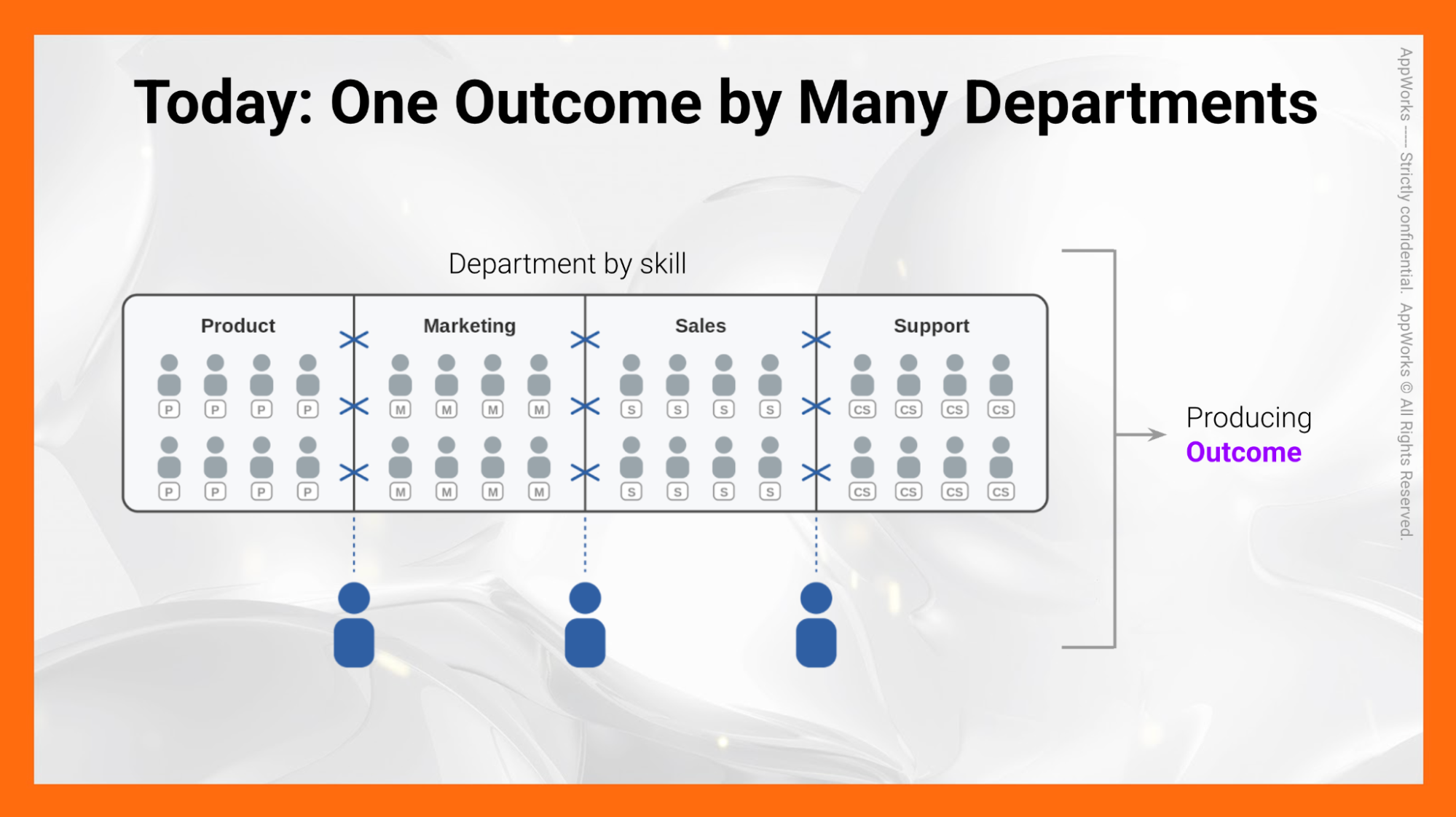
Look at a company today. A single customer outcome is typically sliced across four departments: product, marketing, sales, and customer service. Each holds its own meetings and accountability to stay aligned. And most of a knowledge worker’s day is spent moving data between systems: from email into the CRM, from a report into a slide deck. Enterprise IT even has a formal term for this: the swivel-chair integration, swivelling this way to copy, and swivelling that way to paste. With a desk full of systems and tools, the knowledge worker is still living in the age of the handloom.
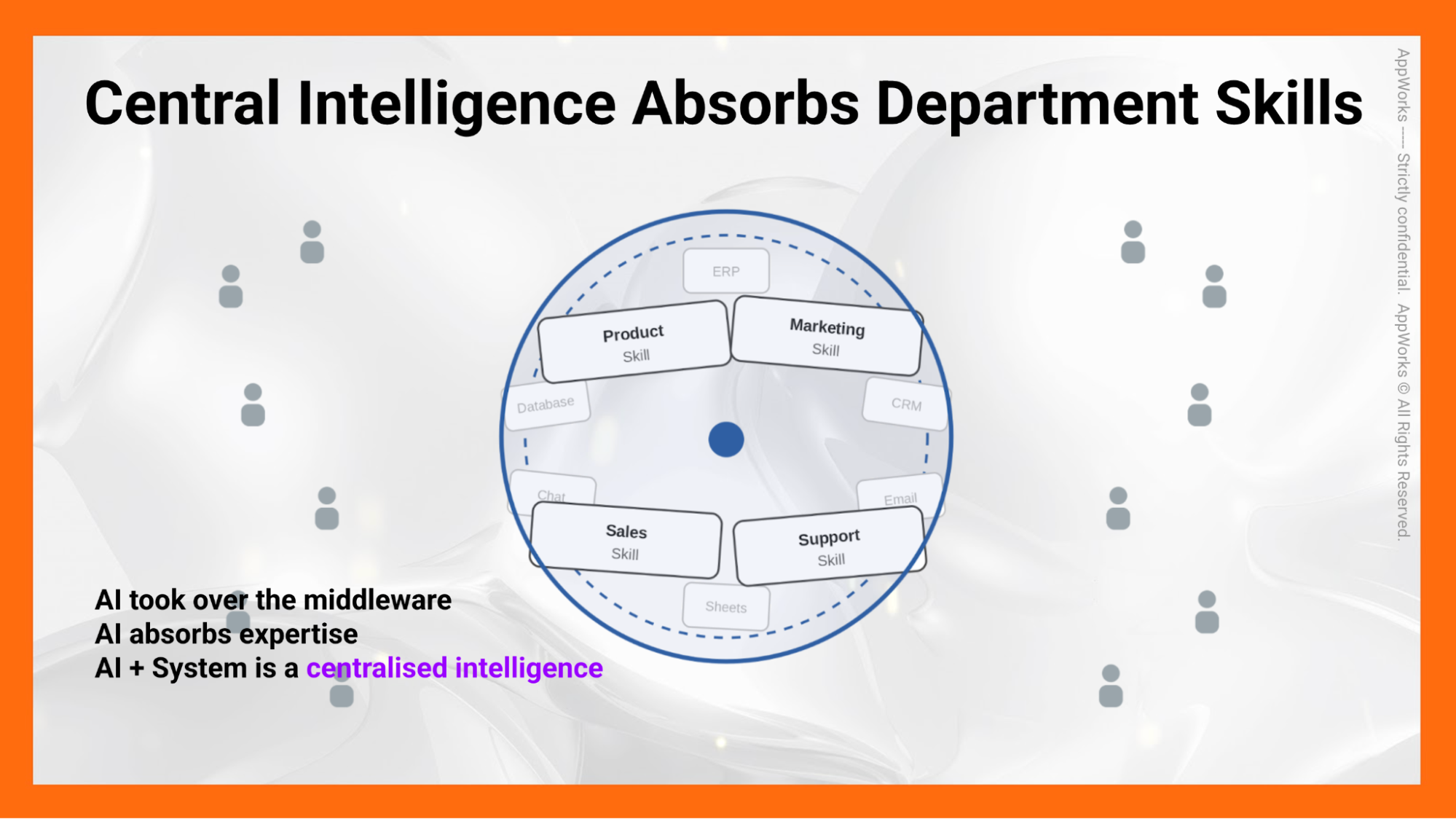
What AI is doing to knowledge work is precisely what the power loom did to weaving: it draws the craft up into the machine. It first takes over the hauling and the stitching, and then absorbs each department’s execution as well: marketing’s ad placement, sales’ quoting, customer service’s tickets all become on-demand capabilities inside the machine. In effect, every back-office function gets an API.
This is the industrial revolution of knowledge work. For the first time, people can truly step to the side of the machine. The next question is the hypothesis we want to discuss today: once people have stepped aside, how should they reorganise and regroup?
Our hypothesis: The New Shape of Work
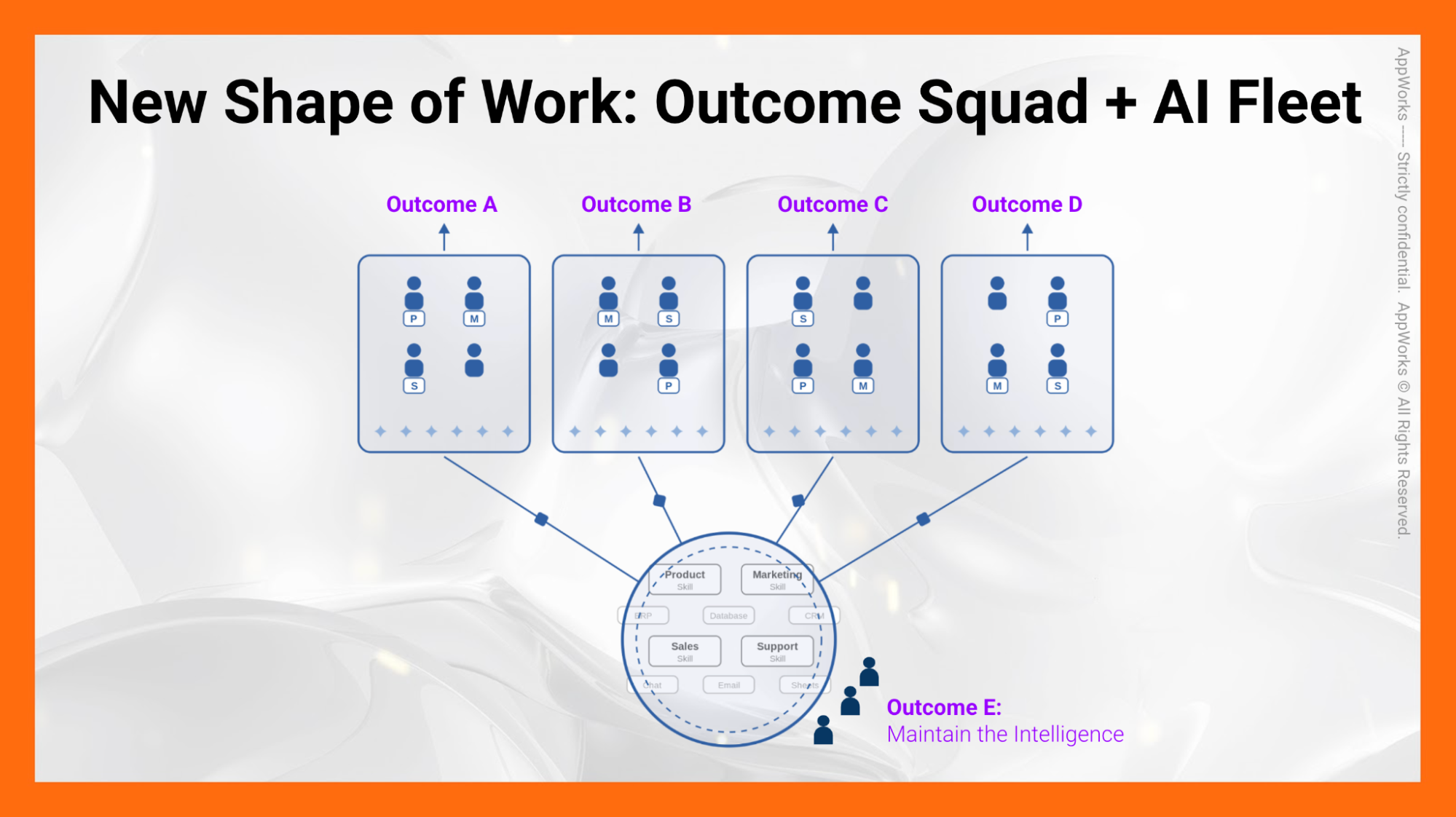
The new shape of work is, first of all, a new shape of the organisation.
Let’s lay out the full hypothesis first. We believe the organisation of the AI era may look like this: at the centre, a shared intelligent machine that takes on integration and execution; around it, a ring of small, self-sufficient outcome squads — two to five people plus a fleet of agents — each owning one outcome end to end; and expertise is no longer the name of a department; it is the repertoire a person brings to the work — a craft honed inside a guild.
The history of management is full of organisational experiments, and organisation is one of the reasons American firms pulled ahead. Ethan Mollick, the Wharton professor who has written most persistently about organisational change in the AI era, points to an often-forgotten estimate: 20% to 40% of the extra competitive advantage American companies enjoyed in the twentieth century came from better management — it was an era willing to run experiments on the organisation itself. Yet he also laments that most companies later gave up experimenting, outsourcing “how to run a company” to consultants and SaaS vendors (see the interview published by Insight Partners).
Indeed, looking back at management history, we have been through several major rounds of organisational experiment: the U-form of a century ago, grouped by function; then the M-form that grew up in the 1920s, grouped by division — both names in fact had to wait until 1975 for Oliver Williamson to supply them, the shapes having been alive for half a century before the theory caught up; then the amoeba system Kazuo Inamori invented at Kyocera in the 1960s, which split the company into dozens of small units each accountable for its own profit and loss; and on to Spotify’s squad model of the 2010s, copied the world over and yet never really made to live even at Spotify itself (see former Spotify PM Jeremiah Lee’s Failed #SquadGoals). Now AI has reopened the laboratory of the organisation. We would also like to give the new shape a name of its own, and in this article we tentatively call it the S-form: squad-form, an organisation grouped by outcome.
Four key details of the new shape
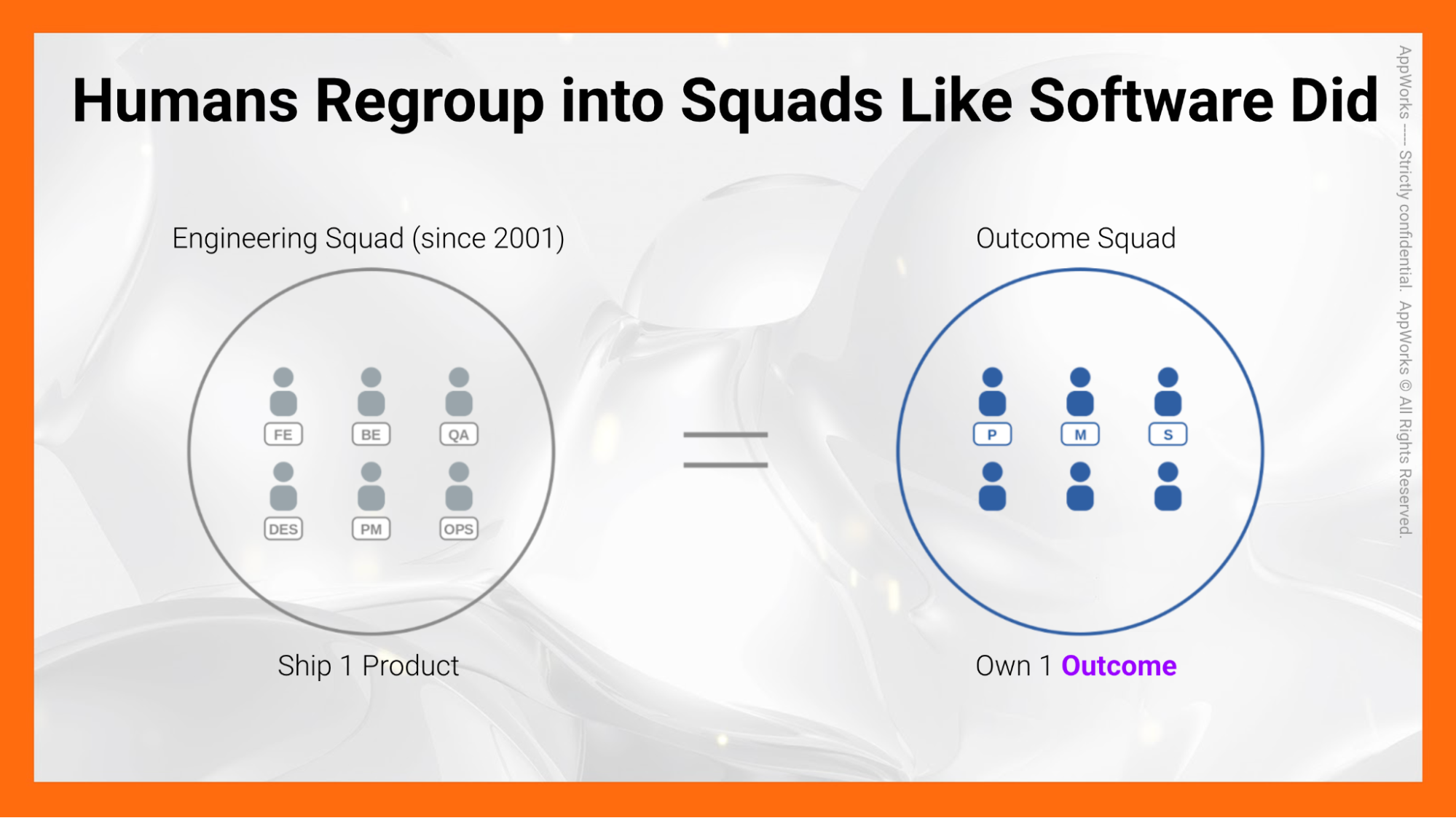
- Group by outcome, not by function.
Software has already taken this step. Since 2001, the engineering squad has put front-end, back-end, QA, design, PM, and ops on one team, accountable for specific outcomes instead of each returning to a functional department to wait in line.
For other kinds of knowledge work, one of the reasons departments exist is that a complete piece of output is beyond one person, or a few: a single campaign takes a whole group to see through, and no one outcome can support a full-time designer, lawyer or analyst of its own. So the only option was to gather people of the same function together and let each person’s time be shared out across different outcomes — at the price of queueing, and of negotiating the order of the queue. Once that output can be supplied by a machine on demand, an outcome no longer needs a full group assembled around it, nor does it need to share a person with anyone else, and the boundaries can be redrawn — drawn between one outcome and the next.
So what the new shape does is extend the same equation across the whole company: one team, one outcome, and inside it the best combination that could be assembled for that outcome — product, marketing, sales, perhaps — each person bringing their own profession, but sitting at the same table. The difference is this: what a squad used to deliver was one specific piece of the whole; in the age of AI, a single team can aim straight at a company-level outcome.
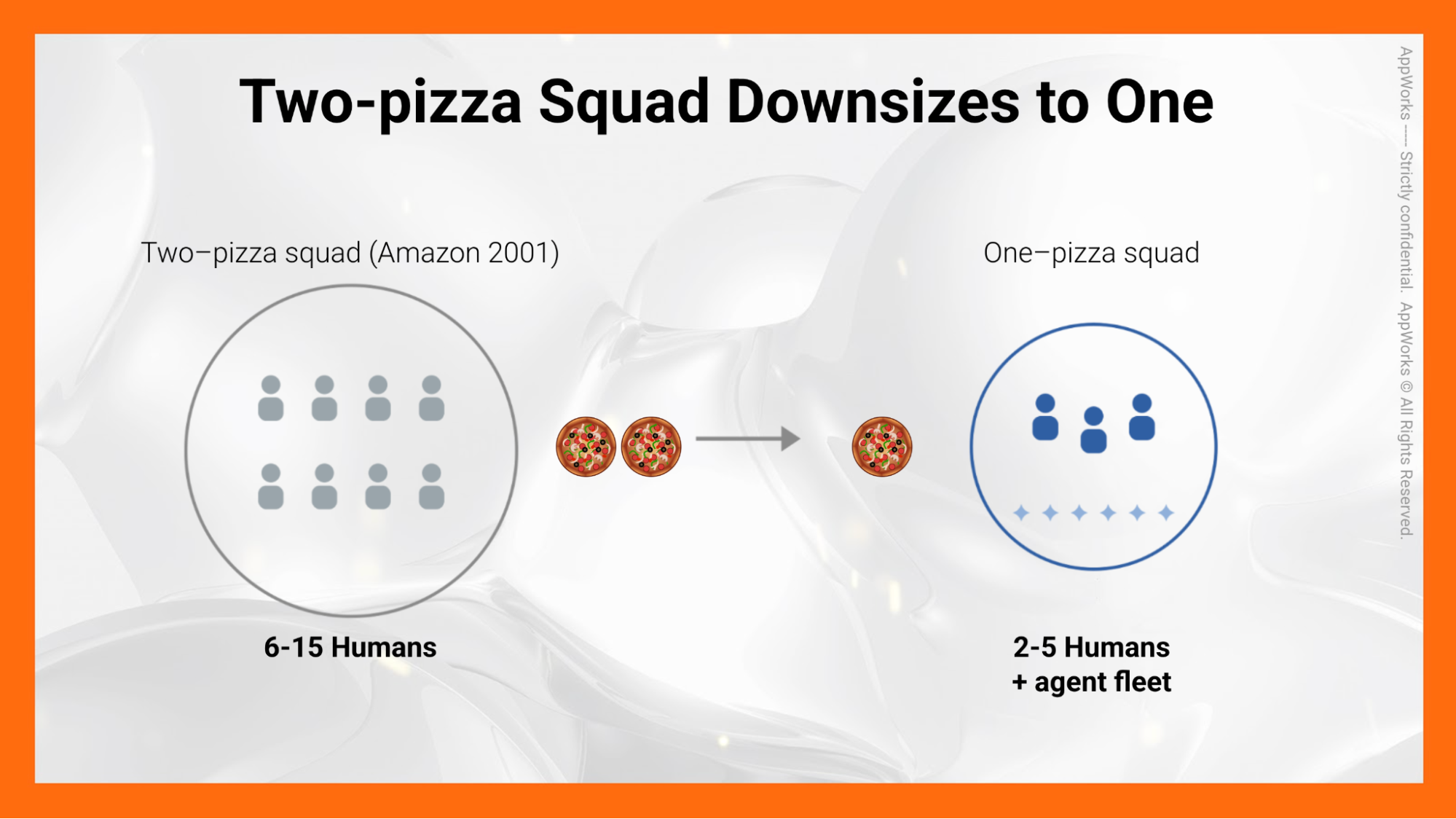
- Squads get smaller.
The software industry’s long-standing reference point has been Amazon’s two-pizza team: small enough to be fed by two pizzas, so under ten people. But the pizzas were never the point. What Bezos actually wanted was a team that owned one thing outright, and Amazon later changed the wording to single-threaded ownership. Once most of the execution sinks into the machine, what is left for people is judgement and accountability — and that takes fewer of them still.
The direction the big technology firms are moving in is already clear: this year Instagram replaced what used to be a thirteen-person specialist line-up with four to six generalist engineers, one product person, plus one specialist relevant to the problem at hand — a pod of roughly six or seven people (from Head of IG Adam Mosseri’s July interview on Lenny’s Podcast). What is worth noting is that the headcount is nearly halved and the composition has changed too: specialists give way to generalists, and the boundaries between functions begin to dissolve into one another.
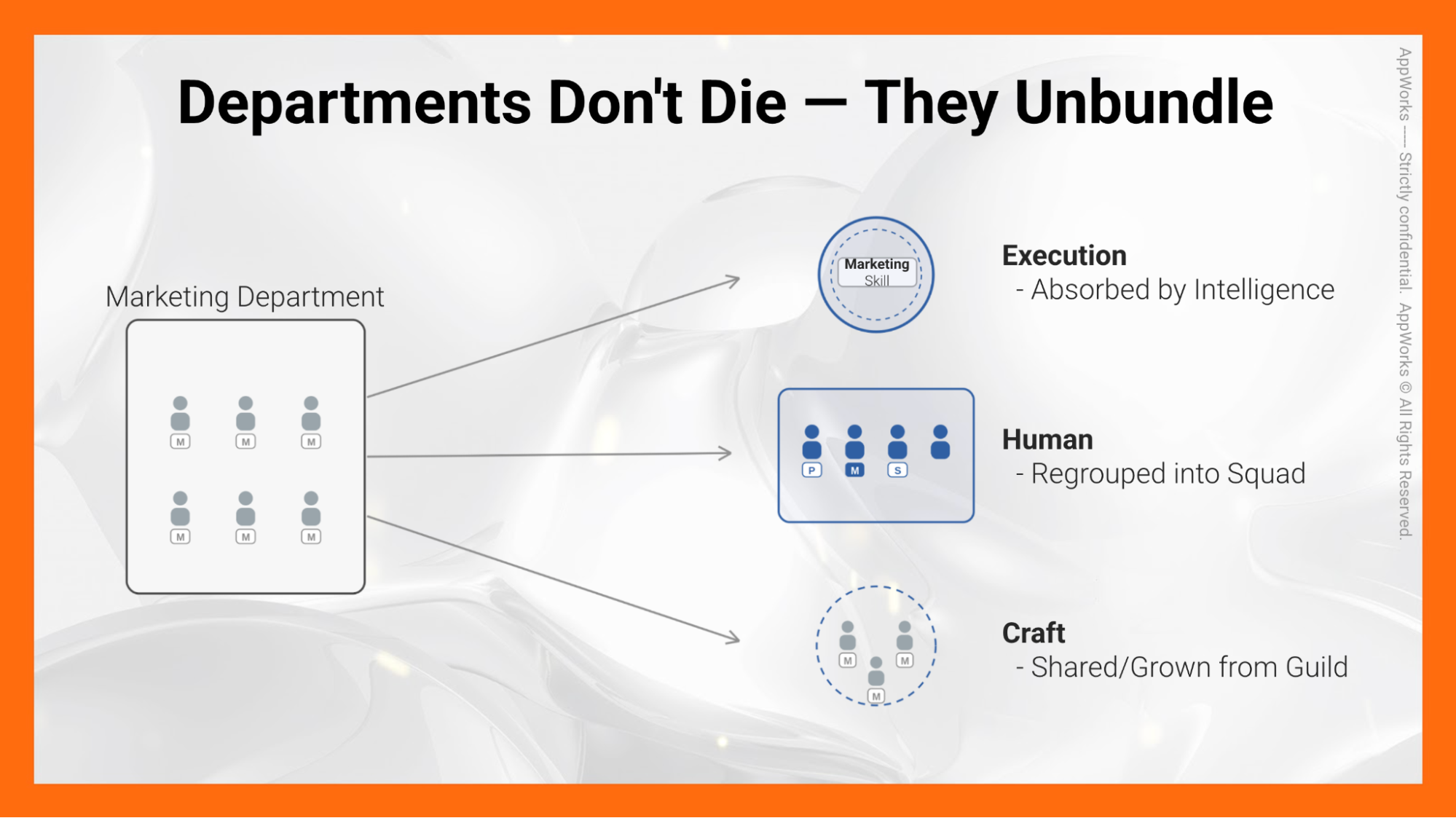
- Departments don’t die; they get unbundled.
This is the most misunderstood step. A department is really a bundle of three things: the capacity to execute, the power to decide whose work a person’s time goes to first, and a home for the craft. The new shape unbundles them, and each goes somewhere different.
Capacity sinks into the machine. The scheduling power simply disappears — once an outcome no longer has to share a person with anyone else, there is nothing left to put in order, and people sit directly in the outcome team. And the community of craft becomes a guild: practitioners of the same discipline still gather to trade experience, hone standards and bring on newcomers, only now the guild sits off the delivery path — it signs nothing off, and nobody queues for it. A profession, then, is no longer where a person belongs, but the practice they bring into the team: visible in the work, yet not the whole determinant of what they can do.
- Underneath is a shared machine, and the people who tend it are a squad of their own.
Management theory named this idea a long time ago: organisational knowledge. In the 1990s, Ikujiro Nonaka described how tacit knowledge becomes explicit, and industry duly built a generation of knowledge-management systems — most of which ended up as graveyards, because a knowledge base only stores, it doesn’t do the work, so nobody had any reason to open it. Thirty years on, a company’s real judgement and real way of doing things still sits, for the most part, in the heads of a handful of people (FunNow’s experiment, later on, comes back to this).
The machine underneath the new shape is the first time that old idea can actually run. It doesn’t merely remember how the company does things; it is where the company does them: integrations, campaigns, quotes and work orders all run inside it. So every run teaches it a little more — though let’s be honest here, the machine does not get cleverer by itself. Someone is tuning context, managing agents and watching yield every day, extracting what happened and feeding it back in. That team is the fab process engineer of the new organisation, and their outcome is the machine itself getting better by the day.
Don’t underestimate this team: encoding a company’s judgement, its knacks and its way of working into the machine, piece by piece, may be the single largest economic undertaking of the coming decade (a point also made by George Sivulka in an a16z article) — and every company has to do it for itself. Nobody can do it for you on contract.
This is also where the new shape’s biggest risk is buried: a shared machine is a shared dependency. If every team has to queue for this one team to supply the capability it needs, the queue you just dismantled grows straight back, merely in a different place. So the design principle for this machine is not to build bespoke features for each team, but to turn capabilities into interfaces the teams can plug into themselves — otherwise it becomes the new internal agency, which is precisely the thing the new shape set out to dismantle.
Field notes from the pioneering founders
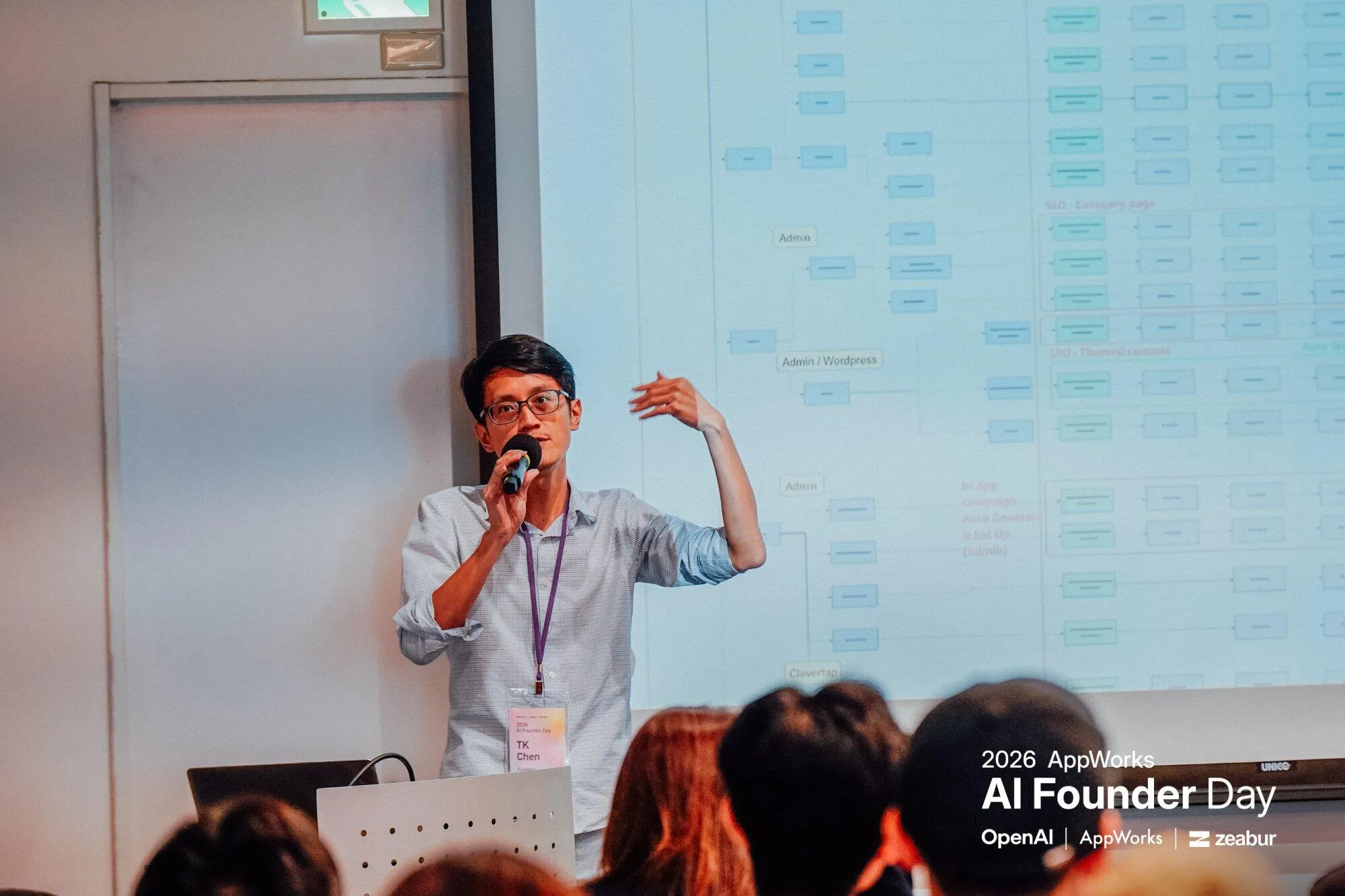
FunNow: how a growth-stage GSEA startup is rebuilding its organisation, squad by squad
The most complete experiment notes from our interviews came from FunNow, a booking platform for hospitality, dining and lifestyle services across Taiwan and Greater Southeast Asia (GSEA), led by group founder and CEO TK Chen, who is a member of the Paramount CEO Club in Taiwan and a regular mentor in the AppWorks community. (Note: Paramount CEO Club is a community for CEOs from companies at growth stage or beyond. It was established by AppWorks in 2012 and has two chapters, in Taiwan and Indonesia.)
FunNow’s org chart today has no CMO and few management layers; increasingly, squads report straight to the CEO. Squads are organised by company-level outcome rather than function: one squad for conversion, one for membership and repeat purchase, one for booking flow, with payments and notifications bundled into a “core” squad. Every squad is designed to last at least twelve months, with two or three adjacent goals bundled so a team doesn’t disband when one is done. After all, familiar people and the rapport between them are still a critical part of organisational efficiency.
The motive is not fashion. FunNow is ten years old; efficiency and profitability are pressing concerns; and functional departments carry a structural friction: one outcome split across departments, priorities that can’t be reconciled, disputes landing on the CEO’s desk. When one squad owns one outcome, “you no longer have to negotiate other departments’ schedules every day.”
The human-to-agent ratio is set by how critical the interface is: “Membership features are simple, so the developer can be an agent. Payments and booking touch the core, so it may take two human developers and three agent developers.” The 2025 Annual Work Trend Index from Microsoft calls this the human-agent ratio — it has an optimum, not a maximum. Roles are allowed to blur (“once the UI/UX is drawn, why not add an agent and push the code yourself?”), but every squad keeps a permanent DRI (directly responsible individual).
Interestingly, Dorsey’s experiment has DRIs too, but there they are temporary roles that rotate with the task and follow the problem; what he really wants to remove is the permanent management layer. On this point, we agree with TK: that step goes too far. TK’s version keeps the DRI as a permanent person — “whoever answers for the failure gets the final say.” After all, it is people, not agents, who can be jailed or sued.
The rollout is incremental: “Each time a new independent mission is confirmed, I pull out an outcome squad led by a DRI, and the old organisation gets remade bit by bit.” Marketing is furthest along, with agents running the chain from signal to execution while people judge and approve. From ad ideation to going live on Meta and Google used to take two weeks; it now takes under a day, and local marketing per country went from three people to two. “How short can you make the chain from market signal to executed response? A week, a day, an hour — that is what competitiveness means in the AI era.” Adoption is an armoury, not a mobilisation order: “AI is a weapon. Let everyone use it. If it works, double down.” Within months, users were modifying the agents themselves.
The biggest bottleneck, he says, is institutional knowledge: the organisational World Model Dorsey describes “right now lives in the heads of individual managers and founders.” TK’s fix is to consolidate tools to two or three, then run weekly and monthly automated extraction so what happens becomes a company asset. The risk he names: when everyone is a builder, data permissions and deployment discipline will be the next governance problem.
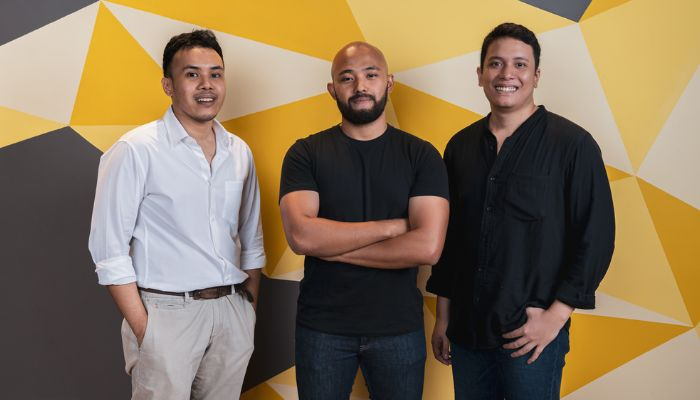
Staffinc: an Indonesian startup’s answer to uneven tech literacy
The second set of notes comes from Indonesia. Founder Wisnu Nugrahadi is a member of the Paramount CEO Club in Indonesia. His startup, Staffinc, is an AI staffing company backed by AppWorks Fund. Wisnu began aggressively remaking the company after the shock of ChatGPT in 2023, and today it is a growth-stage startup with ten times the management efficiency of a traditional staffing agency (note: measured as the number of contract workers each HR staffer can manage).
Wisnu is frank that the market conditions he faces are not comparable to a mature economy’s: the gap in tech literacy among employees is enormous. So he has run a great many experiments — first equipping everyone with AI, then building an in-house enterprise AI along the lines of a World Model with agents, and now a further step: give up on everyone becoming an AI builder, but make sure every team has a top-tier AI engineer.
“It’s too expensive. When you give every employee AI, not every employee produces more, while the training and token costs are staggering.” When their local team’s fluency with the tools can’t keep up, don’t count on everyone becoming a high-performance AI user. So their latest approach is to embed one engineer in every sales squad (squads are organised by customer type), responsible for all the tools and systems that squad needs — in effect, an internal forward-deployed engineer (FDE).
The biggest management innovations are (1) changing how engineers are evaluated: their performance is judged on the squad’s sales results, not by the engineering team; and (2) these deployed AI engineers still return to the engineers’ guild every week to swap the tools and lessons they have built, so that each squad’s learning becomes the whole company’s asset.
The same shape grows different transitional forms in markets at different levels of maturity — one more illustration that “shape follows what actually works.”
Earlier-stage startups finding their way
The Staffinc case shows that embedding AI into an organisation and getting outsized leverage from it is never a matter of the founder drawing a blueprint and following the script; it is a process of iteration and trial and error. Founders’ key concerns are broadly the same: lower cost, higher efficiency, new revenue. However, the path there has to be found by the founder leading the team, growing the new shape that best fits the company’s DNA. That is true for relatively well-resourced growth-stage companies, and all the more so for small startups running extremely lean.
無毒農 (AW#5), a fruit-and-vegetable e-commerce company in Taiwan, learned this the hard way. Founder Enzo initially handed AI adoption to his CTO to lead, but months went by with no results. So Enzo rolled up his own sleeves: he started with n8n and the most repetitive work in customer service, then reshaped the engineering team’s makeup and working habits, and went on to build an internal company MCP (Model Context Protocol) server so that both AI tools and everyone on the team could pull the data they needed. The results: doubled customer service efficiency, sales up 30%, and product development capacity doubled outright.
Tammy, founder of the blockchain team Numbers (AW#23), started by building an AI culture: every team member gets a US$20 monthly AI experimentation budget, the whole team demos their output weekly, and Tammy helps debug personally. Through six months of experimenting, she moved the people who couldn’t adapt to the AI culture out of the organisation. She then found that the cost of moving information between the existing SaaS systems was extremely high and AI couldn’t connect them effectively, so she cancelled all SaaS subscriptions and built the company an AI management system by hand, starting from the calendar. Each stage was built on the foundation of the one before, not a roadmap drawn at the outset.
Farmio (AW#31), a Singapore-based AI solution for the food supply chain, was founded in the GenAI era and built AI-native from day one. What an AI-native food supply chain actually looks like was something founder Paco designed himself, starting from the smallest scenario: ordering via WhatsApp. He entered at the highest-frequency touchpoint in the entire supply chain and extended down the chain one link at a time. Two years on, 72 agents cover every workflow, ordering to delivery is almost fully automated, and the company has hit the milestone of US$1 million in GMV per employee.
These three cases show the different paths smaller startups in the AppWorks community have taken, and each started its experiment at one clearly defined point: customer service, internal tools, ordering. Beyond that, the founder’s own resolve to change was critical to their success. The new shape of an organisation cannot be a job that gets outsourced — which brings us back to Professor Mollick’s lament: for decades, many companies outsourced “running the business” to consultants and system vendors, and the pioneers of this round of organisational experiments are taking it back into their own hands.
The new shape gets you the ticket; the real arena is atomic capabilities and moats
To pull the threads together: what we have been discussing is a new shape for the organisation. Over the past six months, founders have been busy chasing the rapid evolution of AI technology, and simultaneously innovating on organisational shape to keep pace. That is the common starting point of every experiment in the first half of this article. But once you have the new shape, there is one more layer to think through: a shape is something visible and copyable. When it goes from a few people’s experiment to every company’s standard equipment, what will actually decide who wins?
In the short term, the gap between companies will come from who compounds learning first: the same headcount, several times the output. That gap is already measurable. Using the same frontier models, companies that hand out tools without touching the organisation see engineering productivity gains of roughly 20% to 40% (Theory Ventures’ data), and some rigorous controlled experiments have even measured negative values; companies that rebuild AI into their workflows see 2.5x to 3x (interview with Anthropic engineers); and in Taiwan we have already seen leading software companies reach at least 10x production speed. Everyone has the same models; the variable that makes a tenfold difference is not the model but how the organisation is built around it.
But over a longer horizon, a shape is something visible and copyable. Once every company has grown into the new shape, the value of leading on execution and efficiency will eventually be competed away, and quickly. At that point, the decisive factors come back to two things. First, atomic capabilities — for FunNow that might be price discovery and the entertainment options it curates; for Staffinc, guaranteeing the quality and quantity of its contract workforce — and these atomic capabilities will be sorted into winners and losers ever faster. Second, moats that AI cannot take away: the licences, distribution, brand, and data loops a company needs in order to strengthen or defend that atomic capability.
But don’t read “will be competed away” as “doesn’t matter.” A company that fails to grow the new shape will very likely not even get a seat at the table. The new shape is not a trophy; it is the ticket in — and the fastest way to accumulate those scarce assets.
So before you start rebuilding, it is worth asking yourself two questions: is your atomic capability strong enough to be worth amplifying with the new shape? And what is your moat?
Closing thoughts: an invitation from the frontier
In closing, we want to be honest about how this revolution feels right now: it is not entirely romantic. In a 2026 survey of nearly 6,000 tech workers, only about one in five feared being replaced by AI, while more than half feared “doing more work for the same pay.” For founders, this is not employee anxiety; it is a diagnosis. Hand out tools without changing the shape of the organisation, and the capacity AI creates ends up backfilled as more meetings and longer hours. Being filled up is not a side effect of AI; it is a symptom of the old shape.
Over a longer horizon, people’s place in the organisation tends to move toward the most valuable thing they do: judgement. After the spreadsheet arrived in the 1980s, the US lost about 400,000 bookkeeping and accounting clerks but gained about 600,000 accountants, and FP&A emerged as an entirely new job category. So the real question was never “how many employees will AI replace?” It is: when the machine gives the hours back to people, where should those people be redeployed?
No one can answer this for you, and it is the most important decision a founder faces right now. Every pioneer’s opening move was small, so if we had to give one concrete piece of advice: pick the outcome that hurts you most and that you can describe most clearly, take it out of the departments’ hands, and give it to a squad of two to five people plus a fleet of agents, with independent metrics and at least twelve months. You will quickly find out what your company’s new shape looks like.
Finally, my recent favourite book is Benjamín Labatut’s When We Cease to Understand the World. Every time one of its scientists ceases to understand the world, a new theory is about to be born. For the first time in 25 years, the org chart is on the verge of being redrawn: the uncertainty, the fumbling, are proof that we are standing at the frontier. Over the past hundred years, each generation of operators experimented on their own companies, and each left behind a name: the U-form, the M-form, the amoeba. Whether the S-form becomes the next letter is up to this generation of founders and their experiments.
At the start of the AI era, it is our honour to explore this new frontier with you.
